marți, 26 aprilie 2011

luni, 11 aprilie 2011
The Rhetorical Question
The Rhetorical Question. The product of sarcasm? Yes. So how exactly is it rhetorical? Well, a simple definition of the rhetorical question is that it is a question that is asked simply to make a statement. It is not meant to be answered, only to get a point across.
The rhetorical question can be used to make an observation.
example- "Did you get dressed in the dark today?"
The speaker really isn't asking if your electricity was out when you picked out your ensemble. He's making an observation that your outfit is ugly, and you should probably be embarassed by it.
The rhetorical question can also be used to express an emotion.
example- "Why does this always happen to me?"
The speaker isn't speaking to a higher being, asking what he may have done to deserve such "treatment." He is simply expressing frustration, anguish, etc.
Click here for the Uncyclopedia's humorous definition of the rhetorical question.
The rhetorical question can be used to make an observation.
example- "Did you get dressed in the dark today?"
The speaker really isn't asking if your electricity was out when you picked out your ensemble. He's making an observation that your outfit is ugly, and you should probably be embarassed by it.
The rhetorical question can also be used to express an emotion.
example- "Why does this always happen to me?"
The speaker isn't speaking to a higher being, asking what he may have done to deserve such "treatment." He is simply expressing frustration, anguish, etc.
Click here for the Uncyclopedia's humorous definition of the rhetorical question.
joi, 7 aprilie 2011
Wat r u tryna tll me?
Text lingo. Ew. The thought of it makes me shudder. Not only does it completely defy all rules of grammar and spelling ever established, it is also nearly impossible to tell exactly what a person is trying to say. What I mean by that is, when you're speaking with someone in person, you have their facial expressions and the tone of their voice to clue you in on whether they're being mean, sarcastic, sweet, etc. Even when you're speaking with someone via phonecall, you still have the tone of their voice to clearly demonstrate what they mean.
So many arguments break out via text because someone misconstrues what the other person is trying to say. There are no cues to help us figure out the exact meaning of the text.
So many arguments break out via text because someone misconstrues what the other person is trying to say. There are no cues to help us figure out the exact meaning of the text.
vineri, 18 martie 2011
Say what?
When I was brainstorming what to write about this week, the first idea that came to mind was Obama's reaction to the situation in Japan. The entire speech seemed okay; he is a very eloquent with, with excellent speaking skills. However, one line in my head stood out. The exact words escape me now, but the idea was essentially something like this: "I'm from Hawaii, so I have an understanding of the Japanese culture."
Uh, what?
This seemed completely irrelevant and almost made no sense. For a second, I pondered why he said this, but then I realized that the purpose of this comment was to gain an emotional reaction from the audience. He wanted to relate personally to the event and gain more credibility in his opinions and decisions regarding it. My first thought when I realized this was, "Typical politician." Is it just me, or do they all seem to make irrelevant comments just to get a reaction?
Uh, what?
This seemed completely irrelevant and almost made no sense. For a second, I pondered why he said this, but then I realized that the purpose of this comment was to gain an emotional reaction from the audience. He wanted to relate personally to the event and gain more credibility in his opinions and decisions regarding it. My first thought when I realized this was, "Typical politician." Is it just me, or do they all seem to make irrelevant comments just to get a reaction?
joi, 3 martie 2011
Nobody's Got My Vote
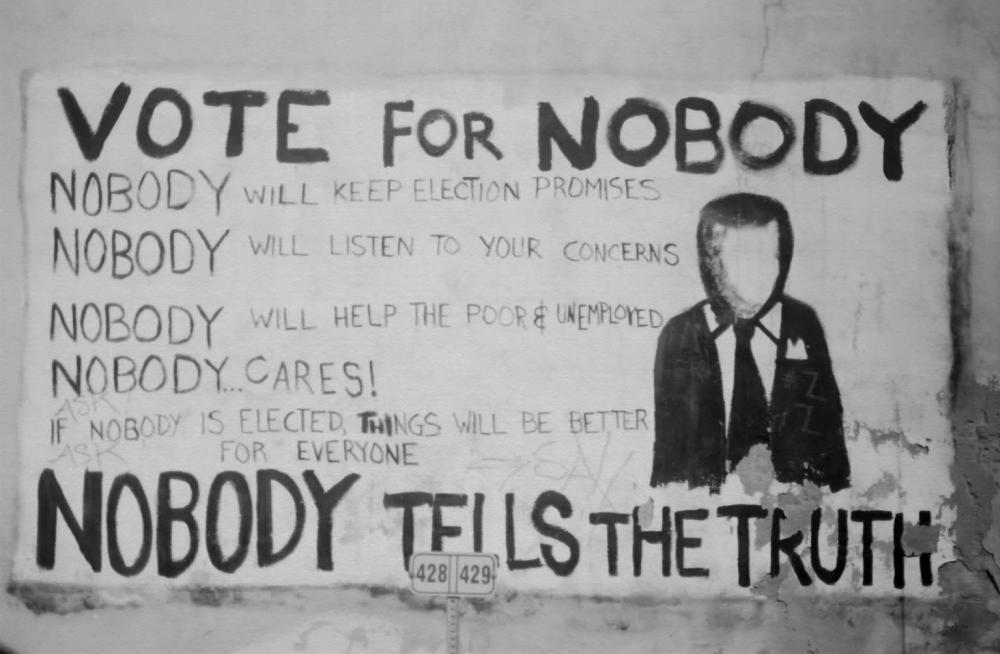
There is so much going on in this picture. First off, I'd like to say that I feel like it could be a pro-Anarchy picture, simply because of the fact that it is advocating a government without a leader, saying that that is the best option. There is no information given confirming or denying that, though.
There is also the silhouette of a faceless man dressed in business attire beside the text, presumably "Nobody." This gives the text two meanings: one with nobody as a general pronoun, and one with Nobody, the optimal candidate for everyone.
This picture makes its message very clear, but what strikes me every time I look at it is the truth that it speaks. Sure, there are a few good people who do some of those things, but when it all comes down to it, telling the truth is usually what people fail to do.
Credit: http://browse.deviantart.com/photography/?qh=§ion=&q=graffiti#/de4mgp
joi, 24 februarie 2011
Rhetorical Analysis Essay
I think this is going to be my topic for the essay. Feedback?
http://www.thecobrasnose.com/xxghost/handprint.html
http://www.thecobrasnose.com/xxghost/handprint.html
marți, 15 februarie 2011
Analyzing Rhetoric Assignment
For this assignment, I will be analyzing *drumroll, please* THE OLD SPICE COMMERCIALS.
joi, 3 februarie 2011
The Land of the...Cool?
After watching this commercial the first time, I really didn't know what to think. Should I be offended? Should I laugh? All of my Romanian friends were posting links to this video on Facebook, infuriated that their national chocolate, Rom, had been Americanized.
Okay, maybe I should give some background information first. In Romania, Americanization is a sensitive topic. Many, if not the majority of the population, believe that America is gradually taking over the world. Romania is a very small but patriotic country. They have their own language, customs, genres of music, food, etc. English is beginning to sneak its way into daily vocabulary, as Romanians begin to learn it from the day they prove capable of speaking. Muzica Taraneasca has been shoved aside by the youth for the more favorable mainstream American music. Rom chocolate is an object of national pride. Frankly, it is one of the most delicious chocolates in the world (in my personal opinion,) and since the day of its creation, it has been wrapped in the Romanian flag-- a testiment of Romanian patriotism.
This commercial, which relies mostly on ethos, is clearly meant to be taken in a sarcastic way. There is no way that Rom would ever actually replace the Romanian flag wrapper for one with an American flag. This aspect of the commercial evokes a substantial amount of emotion in the viewer. As explained in the previous paragraph, Romanians are very bitter about the Americanization of their culture. I got to see this emotion first hand through my friends' angry Facebook rants.
At the same time, a child who is too young to understand the sardonic nature of this commercial may beg his mother to rush him to the store and buy him some of these "new" candy bars. Why? Because he, being of the younger, Americanized generation, wants to be a star...just like the Americans.
A final emotion-evoking element of this commercial is the fact that it is presented in English, with Romanian subtitles. This simple component is enough to anger any proud Romanian watching it.
All-in-all, I feel that this commercial is an extremely good example of rhetoric based on pathos, and a good representation of rhetoric in a culture other than our own.
Psh, who cares about substance, anyway?
Lunch is a notorious time for my roommate and me to discuss the "controversial" topics we encounter in our everyday lives. Almost every week, at least one of our conversations ends in the following manner.
"You know what I hate?"
"What do you hate?"
"I hate boring people. No one can carry a conversation anymore. I tried talking to someone in my class today, and we ran out of things to say after 20 seconds."
"I agree. It's hard to find people with substance, anymore."
Sad, but true, not many people know how to hold a meaningful conversation nowadays. Simply walking down College Avenue, one will hear countless "he-said-she-said"s, all in varying Valley Girl accents. One will catch snippets of conversations about "how drunk I got last night, brah." However, one will probably not hear anyone discussing the recent happenings in Egypt, the rise in tuition costs, etc. At least, not from anyone under 25 years of age. Occasionally, one may encounter someone with whom he can hold a conversation. The conversation usually gets awkward pretty quickly, though, when one of the people can think of nothing more to say.
Society today is certainly not lacking in the rhetoric department, but the younger generations really need to learn some conversational skills. Or speaking skills, in general.
If they don't, who knows where tomorrow will take us. No one wants to live in a meaningless world, as seen on Jersey Shore. "He-said-she-said" will only get us so far.
"You know what I hate?"
"What do you hate?"
"I hate boring people. No one can carry a conversation anymore. I tried talking to someone in my class today, and we ran out of things to say after 20 seconds."
"I agree. It's hard to find people with substance, anymore."
Sad, but true, not many people know how to hold a meaningful conversation nowadays. Simply walking down College Avenue, one will hear countless "he-said-she-said"s, all in varying Valley Girl accents. One will catch snippets of conversations about "how drunk I got last night, brah." However, one will probably not hear anyone discussing the recent happenings in Egypt, the rise in tuition costs, etc. At least, not from anyone under 25 years of age. Occasionally, one may encounter someone with whom he can hold a conversation. The conversation usually gets awkward pretty quickly, though, when one of the people can think of nothing more to say.
Society today is certainly not lacking in the rhetoric department, but the younger generations really need to learn some conversational skills. Or speaking skills, in general.
If they don't, who knows where tomorrow will take us. No one wants to live in a meaningless world, as seen on Jersey Shore. "He-said-she-said" will only get us so far.
Abonați-vă la:
Postări (Atom)